Mixed-methods research across two countries, 119 participants
Gen Z has grown up with more advertising than any previous generation and with more tools for avoiding it. For a major social media platform trying to make its ad product feel less like an intrusion and more like a natural part of the experience, the question wasn’t just what Gen Z disliked about ads. It was what would actually make them better. What does a more ideal online ad experience look like to the cohort most allergic to traditional marketing?
The research needed to work across two very different markets (the US and India) where platform behavior, cultural attitudes toward advertising, and economic contexts diverge in meaningful ways. A single-market study would have missed that complexity entirely.
The research program was designed as a three-phase mixed-methods study, each method building on the last, following an initial deep dive for building a solid foundation of understanding. The secondary research and parallel set of in-depth interviews with outside subject matter experts — academics specializing in cross-cultural youth studies, and marketing professionals who focus specifically on Gen Z audiences — supplied the macro context underneath the data: how economic and political uncertainty has shaped this generation’s default skepticism, why brand loyalty runs in the opposite direction from prior generations (loyalty flows from the brand to the customer, not the reverse), and just how much internal diversity sits inside a single generational cohort — particularly across India’s tiered cities, where Gen Z in smaller tier-two and tier-three markets looks meaningfully different from their tier-one peers. That context kept the core research from over-generalizing a group that isn’t nearly as monolithic as “Gen Z” suggests.
I co-led the research together with one other researcher, both of us reporting into a design lead who ran the overall program.
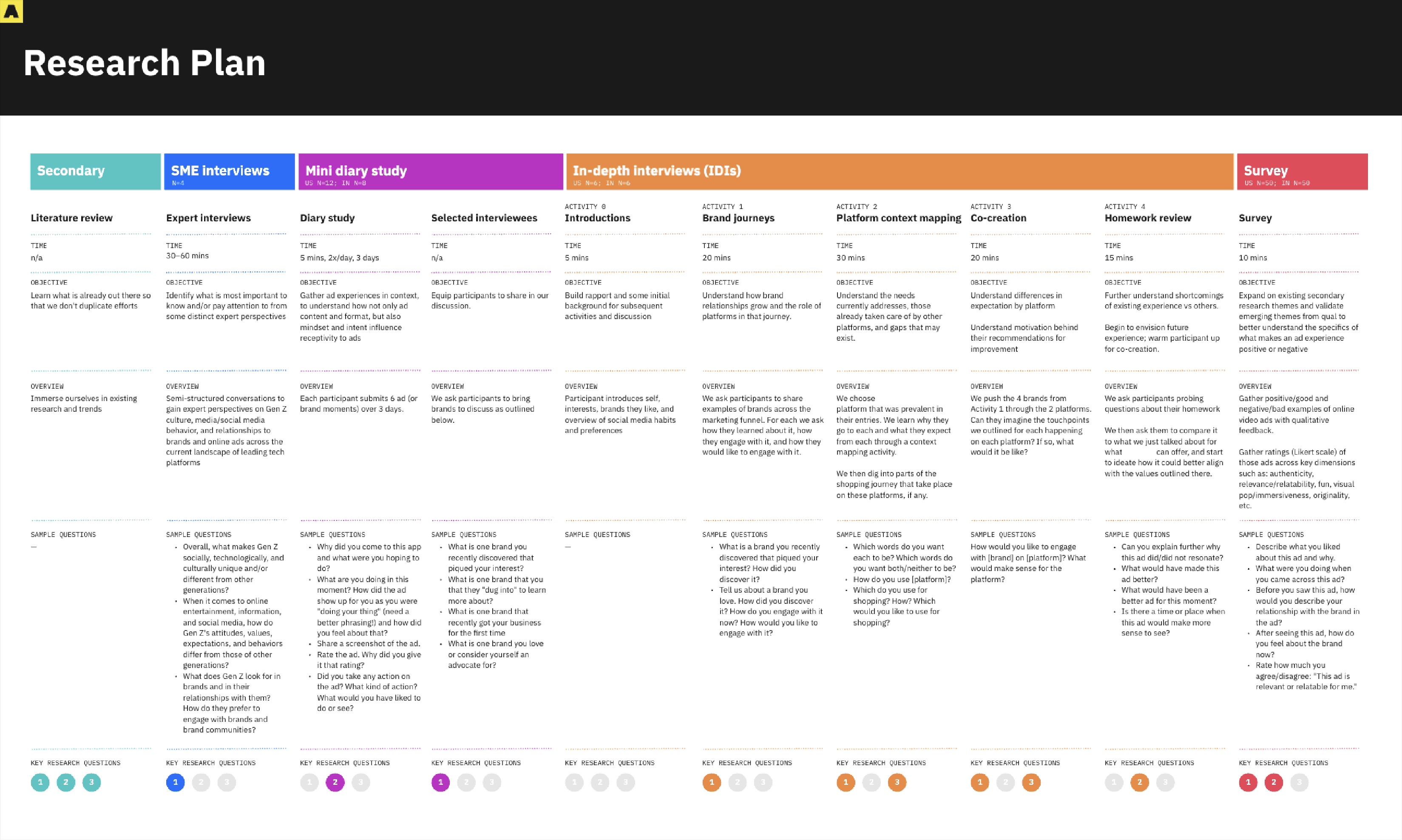
The three-phase mixed-methods research plan built on a foundation of secondary research and subject matter expert interviews: a mini diary study, in-depth interviews, and a closing survey
A mini diary study (n=21) opened the program; participants documented their ad experiences in context, over time, capturing what made an encounter feel positive or negative in the moment rather than in retrospect. This gave us naturalistic data that retrospective interviews alone would have missed: the small friction points, the moments of unexpected relevance, the reflexive swipe-past behaviors.
In-depth interviews (n=12) went deeper, exploring how participants experienced ads across multiple platforms and what they imagined a genuinely better experience might look like. These sessions moved beyond behavior into aspiration — valuable territory for a platform trying to improve rather than just optimize what it already had.
A quantitative survey (n=98, split US/India) then tested whether the themes emerging from the qualitative work held at scale, building confidence where patterns were consistent and surfacing divergence where US and Indian respondents differed meaningfully. Nine ad experience attributes were evaluated: relevance, trustworthiness, brevity, discoverability, native integration, content relationship, emotional versus informational emphasis, action ease, and social connectivity.
Data visualization was a meaningful part of the output, where I used open source rawgraphs.io to produce sentiment maps of how participants described the platform’s ads, segmented by market. The visual contrast between US and India responses was, for example, immediate and legible in a way that tables of percentages weren’t.
Importance ratings across 9 ad attributes, combined and by market
Sentiment bubble maps built in rawgraphs.io: positive vs. negative descriptors
Past the attribute-level data, the research synthesized into a working model of what actually makes an ad resonate for this generation: it has to earn trust, generate real excitement about its specific subject, and fit the mindset the person already happens to be in. The first two needs are comparatively stable — once trust is established it doesn’t swing much day to day, and what excites someone about a product changes slowly, if at all. Mindset is the opposite. It shifts session to session, sometimes minute to minute, which is exactly what made it the hardest — and most strategically useful — of the three to design around.
Three key components of an ideal ad experience for Gen Z
Across the diary entries and interviews, participants described bringing one of three distinct mindsets to content, largely independent of which platform they were on. In a Gallery mindset, they had no fixed idea of what to watch and just wanted to be entertained — the mindset today’s dominant ad formats were built for, inherited from how social feeds evolved from bordered banner ads into “ads as content.” In a Library mindset, they had a specific piece of content in mind and gave it full attention, with little patience for anything standing between them and it — and this turned out to be the platform’s dominant mode far more often than its existing ad formats assumed, meaning most ads were interrupting people at exactly the moment they were least open to one. A third, lighter pattern — a Café mindset, where content plays in the background while someone does something else and tolerates more interruption if the tone fits — also surfaced, though we treated it as a lead for future research rather than a fully developed segment.
The three-mindsets framework: attention and intention as the axes that determine ad receptivity
The synthesis translated into four opportunity areas, informed by the trust-excitement-mindset framework for ideal ad experiences, the three types of mindsets that Gen Z naturally oscillates through on any given day, and by how much of a leap each represented from the client platform’s existing strengths and comparative advantages. The first two were near-term and already underway in some form: protect and extend the trust advantage the platform already held over more casual social feeds, and close the relevance gap by both expanding the pool of eligible ads and then refining and matching ads more directly to lifestyles and interests using stronger signals. The third was a genuine pivot: design distinctive ad experiences for each of the three mindsets instead of forcing one format to work across all of them. The fourth was the most platform-specific and the biggest swing — reframing ads around the search and research behavior people already brought to the platform, so that an ad functioned less like a gate before content and more like a helpful result in its own right.
A must-do. Ensure ads are trustworthy by leaning into the client’s comparative advantages, the strong relationship it’s already built with Gen Z users over more casual social feeds, and targeted innovation.
A must-do. Make ads feel more exciting and relevant to Gen Z users. Expand the ad pool and refine matching algorithms, rather than assume currently existing signals are enough.
A real pivot. Re-design ad experiences to better match each user mindset instead of one format for all three. Create distinctive experiences that coincide with Gen Z’s intention and attention at any given moment.
Platform-unique. Reframe the ad paradigm around search and research behaviors, providing results rather than gates or disruptions.
The research delivered a clear, evidence-grounded picture of the ideal Gen Z ad experience and the significant gap between that ideal and what the platform was currently delivering. Key findings showed that brevity and trust were the top-ranked ad attributes globally, while social connectivity ranked lowest. Relevance landed in the middle, suggesting that targeting alone is not sufficient — a short, trustworthy ad outperforms a targeted but long or opaque one.
The US/India split also revealed meaningful divergence: Indian participants rated nearly every attribute as more important than US participants, suggesting higher baseline expectations and greater openness to ads that earn engagement. This cross-cultural nuance directly informed platform strategy for two distinct markets rather than a single averaged recommendation.
An ideal ad experience framework combined with an emergent model of three distinct user mindsets based on intention and attention generated four opportunity areas with corresponding design principles and “what if?” prompts to kickstart subsequent ideation efforts and innovation strategies.
Participants across three methods — diary study, in-depth interviews, and survey — providing a layered, triangulated picture of Gen Z’s ad experience.
Distinct market profiles (the US and India) with clear, actionable differences in how participants experienced and prioritized ad attributes.
Trust and brevity ranked as the highest-priority ad attributes globally, ahead of relevance, native integration, and discoverability.
Sentiment maps built in rawgraphs.io made the emotional texture of participant responses immediately legible, highlighting positive versus negative descriptors, by market.